


Imagine trying to study plants nearly 200 years ago. There were no digital cameras. No smartphones. No field guides filled with glossy photographs. If a botanist wanted to share the shape of a fern or the delicate branching of a piece of seaweed, they had only one option: draw it by hand.
For someone trying to document hundreds of different species, that was a slow (and often imperfect) process.
Then, in the 1840s, a remarkable woman named Anna Atkins discovered a new way to preserve the beauty of plants using nothing more than sunlight, chemistry, and paper.
Her work would forever change the worlds of science, art, and photography.
Today, nearly two centuries later, families can recreate that same process in their own backyards.
In this Entry:
- Who Was Anna Atkins?
- The Birth of the Cyanotype
- Why Cyanotypes Were Important to Science
- How Cyanotypes Work
- Making Your Own Cyanotypes
- Tips for Beautiful Prints
- Taking the Learning Further
- Our Favorite Resources
WHO WAS ANNA ATKINS?


Anna Atkins (1799–1871) was an English botanist, illustrator, and one of the earliest photographers.
At a time when women rarely received formal scientific educations, Anna's father, scientist John George Children, encouraged her curiosity. Together they collected plants, studied botany, and explored the natural world.
Anna became especially interested in algae, seaweeds, ferns, and other botanical specimens. Like many scientists of her time, she carefully preserved plants by pressing and drying them. She built a herbarium, but quickly realized that it was not feasible to share this widely with others due to its delicate nature.
When she learned about a newly invented photographic process called the cyanotype, she immediately recognized its potential.
Instead of drawing every specimen by hand, she could create beautifully detailed images directly from the plants themselves.
In 1843, she published Photographs of British Algae: Cyanotype Impressions, widely recognized as the first book ever illustrated entirely with photographs. Her work combined careful scientific observation with extraordinary artistic beauty, proving that science and art could exist side by side.
THE BIRTH OF THE CYANOTYPE
The story of the cyanotype begins in 1842 with English astronomer and scientist Sir John Herschel. While experimenting with light-sensitive chemicals, Herschel discovered a simple photographic process that produced vivid blue prints. His goal wasn't to create art- it was to develop an efficient way to reproduce notes, diagrams, and scientific documents.
At the time, photography itself was still in its infancy. The daguerreotype had only been introduced a few years earlier, and photographers were experimenting with new ways to capture images without relying on an artist's hand.
When Anna Atkins learned of Herschel's discovery, she immediately saw something that others hadn't.
As a botanist, she understood how difficult it was to accurately illustrate plants. Even the most talented botanical artists could accidentally leave out tiny details or introduce subtle inaccuracies. Delicate algae, ferns, and seaweeds were especially challenging to draw before they wilted or changed shape.
Instead of sketching her specimens, Anna carefully placed them directly onto sheets of cyanotype paper and exposed them to sunlight. Every vein of a leaf, every branching frond of seaweed, every tiny stem was recorded exactly as it appeared in nature.
In 1843, she published Photographs of British Algae: Cyanotype Impressions, now recognized as the first book illustrated entirely with photographs. At a time when both photography and women's contributions to science were still in their infancy, Anna quietly demonstrated that the camera could become an extraordinary scientific tool.
Nearly two centuries later, families around the world are still making cyanotypes using the very same process. While today's paper comes pre-coated and ready to use, the magic hasn't changed much since Anna carefully arranged seaweed on blue paper in the mid-1800s. With nothing more than sunlight, water, and a bit of patience, we can create beautiful botanical prints and experience the same sense of wonder that she did.
WHY CYANOTYPES WERE IMPORTANT TO SCIENCE
One of the things I love most about Anna Atkins' work is that she wasn't making art simply for art's sake. Instead, she was solving a scientific problem.
Her cyanotypes captured details that even skilled botanical illustrations sometimes missed. Tiny veins in a fern, delicate branching patterns of algae, and intricate leaf shapes appeared exactly as they existed in nature. Her photographs became valuable scientific records.
Even today, cyanotypes remind us that careful observation is at the heart of both science and art.


HOW CYANOTYPES WORK
The process is surprisingly simple. Special paper is coated with light-sensitive chemicals.
When objects are placed on top and exposed to sunlight, the uncovered paper reacts with the UV light.
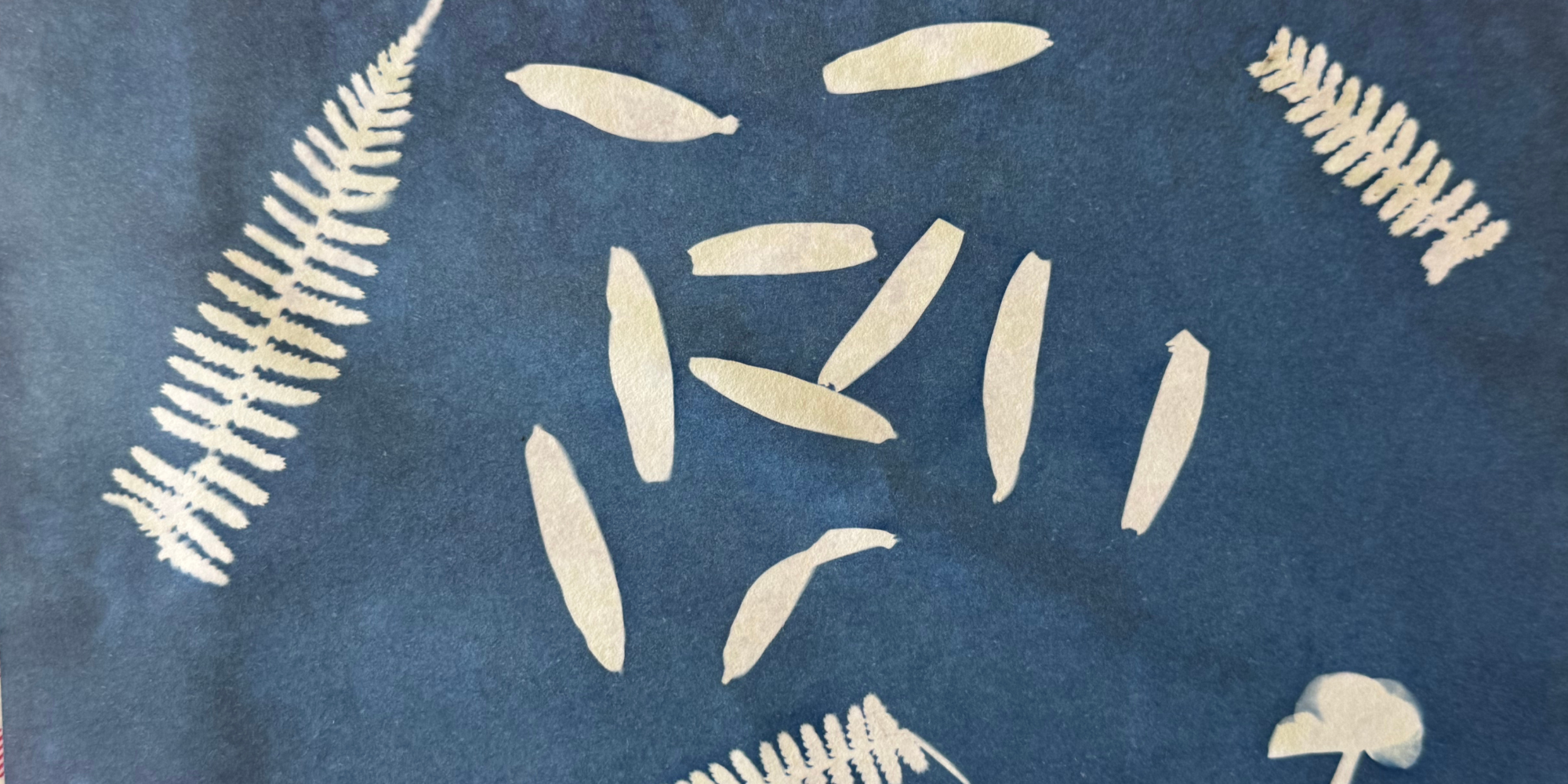
After rinsing the paper with water, the chemical reaction stops, revealing brilliant blue backgrounds with white silhouettes wherever the sunlight was blocked. It's photography without a camera.
Of Interest: How to make spore prints
HOW TO MAKE YOUR OWN CYANOTYPE
One of my favorite summer activities is making cyanotypes with children! It encourages careful observation while creating something beautiful enough to frame. (Can you imagine a wall filled with beautiful cyanotypes?!)
YOU'LL NEED:
- Pre-coated cyanotype paper
- Leaves, flowers, feathers, grasses, or other flat natural objects
- A piece of clear acrylic or glass (optional, but helps hold specimens flat)
- A tray of water
- Sunshine
DIRECTIONS:
- Choose a variety of natural materials with interesting shapes and textures.
- Arrange them on your sheet of cyanotype paper. Experiment with overlapping leaves or combining flowers and grasses to create a composition. I choose to do this part indoors, away from windows so that it does not begin developing before we are finished arranging.
- If you'd like sharper details, gently place a sheet of clear acrylic or glass over your arrangement. We have purchased packages of cheap frames, popped out the glass, and used that!
- Place the paper in direct sunlight for several minutes. Exposure times vary depending on the strength of the sun, but you'll notice the paper gradually changing color. We typically expose the paper for 5-10 minutes.
- Carefully remove the objects.
- Rinse the paper in cool water until the yellow-green chemicals wash away.
- Lay the print flat to dry.
As the paper oxidizes over the next several hours, the blue becomes even richer and more vibrant! It becomes a stunning record of plants you have found!
Tips for Beautiful Prints
- Ferns create some of the most detailed silhouettes.
- Feathery grasses produce beautiful textures.
- Flowers with thin petals often reveal intricate veins. Flowers like Queen-Anne's-Lace is stunning on a cyanotype!
- Experiment with translucent materials like lace or feathers.
- Try making several small prints before creating one larger composition.
Most importantly- don't worry about perfection! Some of the most beautiful cyanotypes happen by accident.
TAKING THE LEARNING FURTHER
Cyanotypes are a wonderful jumping-off point for deeper learning.
After making your prints, consider:
- Identifying each plant you used.
- Pressing and labeling the specimens in a nature journal.
- Researching whether the plants are native or introduced.
- Comparing leaf shapes from different tree species.
- Creating a seasonal cyanotype collection throughout the year.
- Reading about other women who made important contributions to science.
This simple art project becomes a lesson in botany, chemistry, photography, history, and observation- all at once!
OUR FAVORITE RESOURCES
If you'd like to explore Anna Atkins and cyanotypes even further, here are a few of our favorite resources:
For Families
- The Bluest of Blues: Anna Atkins and the First Book of Photographs by Fiona Robinson- a beautifully illustrated picture book that introduces readers to Anna Atkins and her groundbreaking work. It can be a bit word heavy, so I recommend it for kids 10+!
For Adults
- Anna Atkins: Blue Prints- a stunning collection of her original cyanotypes and botanical work, perfect for anyone interested in photography, botany, or the history of science.
Our Favorite Cyanotype Paper
- We love using pre-coated cyanotype paper because it's simple enough for children while still producing beautiful, detailed prints. It's an easy way to experience the same process that inspired Anna Atkins nearly 200 years ago.