


A few years ago, I noticed something strange. The spring peepers that I look forward to hearing each spring were calling later than I remembered. At least I thought they were.
At first, I assumed I was imagining it, questioning my memory. Memory can be unreliable, after all. Maybe spring peepers had always arrived around this time and I had simply forgotten.
But... I had written it down.
I pulled out an old nature journal and flipped through the pages. There it was: the date of the first peeper calls. The first dandelions. The first hummingbird at the feeder. The first monarch butterfly.
What I was noticing wasn't just a feeling. It was a pattern. That's the power of nature journaling.
Most people think of a nature journal as a place to draw flowers, press leaves, or record bird sightings. While it can certainly be those things, at its heart, a nature journal is a tool for paying attention.
And when an entire family contributes to a shared journal, it becomes something even more meaningful. It becomes a living record of your relationship with the natural world- a place where observations, questions, sketches, discoveries, and memories come together to tell the story of both your landscape and your family.
In this Entry:
- Why Create a Family Nature Journal?
- The Power of Phenology
- Choosing a Journal
- Building a Nature Journaling Kit
- How Everyone Can Contribute
- What to Record
- Moving Beyond Identification
- Creating a Lasting Family Tradition
WHY CREATE A FAMILY NATURE JOURNAL?


In a world where answers are available at the touch of a screen, it can be easy to rush past observation.
We see a flower, we identify it, we move on.
But nature journaling invites us to linger in that moment.
It asks us to look more closely, to ask questions, to notice patterns, and to become familiar with the places we visit again and again.
A family journal takes this one step further.
When everyone contributes, you begin to see how differently each person experiences the same landscape.
One child notices every bird, another is fascinated by mushrooms. Someone else might become captivated by animal tracks. A parent notices which flowers bloom first each spring. Together, these observations create a richer picture than any one person could create alone.
The journal becomes less about recording facts and more about documenting a relationship.
THE POWER OF PHENOLOGY
One of the greatest gifts of keeping a family nature journal is that it naturally introduces you to the study of phenology.
Phenology is the study of seasonal changes in the natural world.
It involves observing and recording recurring events such as:
- The first peeper calls of spring
- The blooming of lilacs
- The emergence of milkweed
- The arrival of hummingbirds
- The ripening of blackberries
- The first frost
- The changing colors of autumn leaves
These observations may seem simple, but over time they tell stories.
The first year, you're simply noticing.
The second year, you're comparing.
By the third year, you begin recognizing patterns.
You start to know when the peepers usually begin singing. You notice whether the maples are turning earlier or later than normal. You recognize that certain wildflowers bloom shortly after others.
Without even realizing it, you're becoming a student of your place. Phenology helps us understand not only what lives around us, but how everything is connected.
It's also one of the most important tools scientists use to understand environmental change. As temperatures shift and weather patterns become less predictable, phenological records help us see how plants and animals are responding.
And it all begins with paying attention.
CHOOSING A JOURNAL
The best nature journal is the one you'll actually use. It doesn't need to be fancy. Read that again. It doesn't need to be fancy.
Some families prefer:
- A large sketchbook
- A three-ring binder that they can add other pages to
- A watercolor journal
- A blank notebook with thick pages
- A handmade journal created together
Choose something that feels inviting and remember that this journal isn't meant to be perfect. Pages will wrinkle. Mud will find its way inside. Leaves may leave stains. Those imperfections become part of the story.


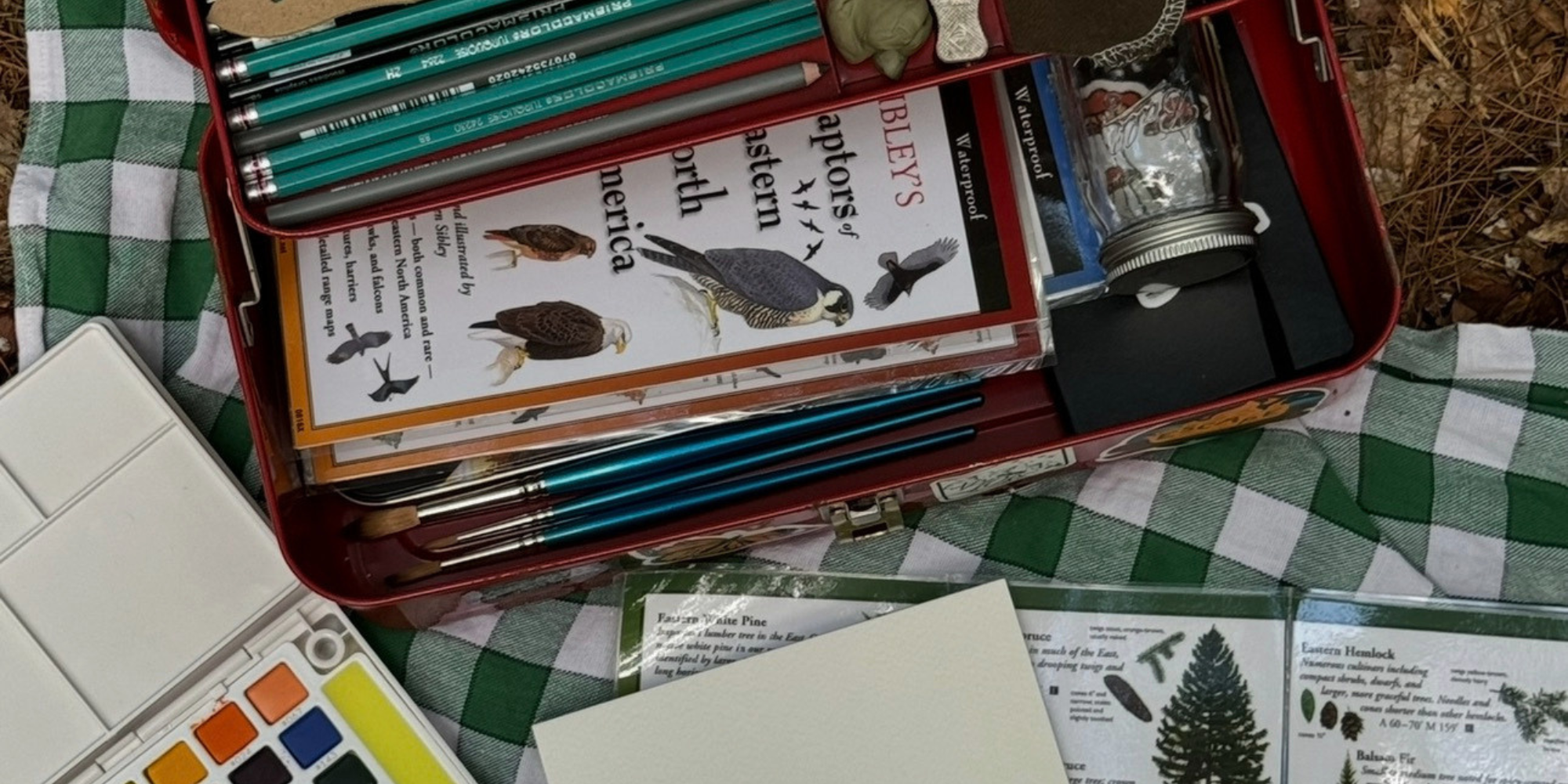
BUILDING A FAMILY NATURE JOURNALING KIT
Having a dedicated kit makes it easier to bring your journal outdoors whenever inspiration strikes.
Consider keeping everything together in a backpack, basket, toolbox, or field bag.
Essentials:
- Family nature journal
- Pencils
- Colored pencils
- Pencil sharpener
- Clipboard
- Magnifying glass
Optional Supplies:
- Watercolor paints
- Fine-tip pens
- Binoculars
- Small ruler
- Glue stick
- Field guides
- Small envelopes for storing fallen treasures
Remember, the goal isn't to carry a full art studio into the woods.
The goal is to create opportunities for observation.
HOW EVERYONE CAN CONTRIBUTE
One of the most beautiful things about a family journal is that every family member can participate regardless of age.
Young children can:
- Draw what they see
- Make leaf rubbings
- Glue in fallen leaves
- Dictate observations
- Record questions
Older children can:
- Create detailed sketches
- Record weather data
- Research species
- Write reflections
- Compare observations over time
Adults can:
- Track phenological changes
- Document family discoveries
- Add identification notes
- Record seasonal observations
There is no right or wrong way to contribute.
A toddler's drawing of a "purple bird" belongs beside a carefully labeled sketch of a red-tailed hawk.
Both represent observation. Both are valuable.
WHAT TO RECORD
Many people become overwhelmed because they think every journal entry needs to be a masterpiece.
It doesn't.
Some of the most meaningful entries are simple observations.
Try recording:
Seasonal Changes:
- First flowers
- First frost
- Leaf color changes
- Snowfall
- Animal migrations
Weather:
- Temperature
- Rainfall
- Wind conditions
- Cloud cover
Questions:
- Why are the acorns falling early?
- What made this hole in the tree?
- Why are there fewer butterflies this year?
Sketches:
- Leaves
- Feathers
- Mushrooms
- Animal tracks
- Insects
- Flowers
Family Discoveries:
- A favorite hiking trail
- An unusual animal encounter
- A successful forage
- A memorable nature moment
A NOTE ABOUT MOVING BEYOND IDENTIFICATION
Technology has made identifying plants and animals easier than ever. What a wonderful thing! As modern-day naturalists, we have access to tools that previous generations could only dream of. But identification is only the beginning.
Knowing the name of a plant is not the same as knowing the plant.
A phone app can tell you that a flower is goldenrod, but it can't tell you whether it bloomed earlier than usual this year. It can't tell you how many pollinators visited it. It can't tell you that your daughter has been drawing that same patch of goldenrod every August since she was six.
Nature journaling helps us balance technology with direct experience. It encourages us to observe first and identify second, to remain present, to ask questions, to build familiarity, and to develop our own relationship with the natural world.
CREATING A LASTING TRADITION
The real magic happens over time. One year, you're recording observations. Three years later, you're comparing them. Five years later, you're noticing changes. Ten years later, you have a record not only of the landscape- but of your family.
You see your children's handwriting change. You revisit questions they once asked. You remember favorite trails and special discoveries. The journal becomes part nature record, part family history.
Consider creating simple traditions around it:
- Seasonal nature walks
- Monthly phenology observations
- Solstice and equinox entries
- Family "favorite discoveries" pages
- Annual reflections
Small rituals create continuity, and continuity is what helps us truly know a place.
A family nature journal isn't really about creating beautiful pages. It's about creating attentive people. It's about learning to slow down long enough to notice the first peeper call, the first monarch butterfly, the changing colors of a familiar tree, or the way a favorite trail transforms throughout the year. It's about building a relationship with the place you call home.
Over time, you'll discover that the journal isn't simply recording nature. It's recording your family's journey alongside it.
And that's a story worth preserving.